Showing posts with label bats. Show all posts

Tuesday, 6 November 2012

The bat cardiovascular system!

My physiology homework:
'Find a recent paper (last 5 years) related to the function of the cardiovascular system, avoiding reviews; that you will present to the group next week'

In order to make this slightly more interesting, I'm blogging about my topic.

You may recall last time I blogged I mentioned my EPQ on bat wings... well, as part of that EPQ I wrote a very brief summary of adaptations in the bat cardiovascular system for powered flight. I didnt really understand much of it at the time, and as it only made up a few small paragraphs in the report I didnt include much detail. After posting the blog a few days ago I reread my EPQ, leading to my decision now to try to improve my knowledge on this topic.

So.... my findings for my EPQ were basically that: the bats heart is very large relative to its body size, with smaller cardiac muscle fibres than for other mammals. This allows more fibres to be compacted into a smaller volume. The venous system (veins) is also different from other mammals as if acts as a storage reservoir for blood, and contains special shunts to help control blood flow. The storage reservoir could have a function in heat regulation during flight or hibernation.

My research paper is entitled 'Application of local heat induces capillary recruitment in the Pallid bat wing'.

If the dilation of the arteries is inhibited by a blockade of a protein called NO synthase, the blood flow through the wing still increases when heat is applied. The aims of the study were to see if this is due to the capillaries.

Bats were trained to remain resting in a box while the heat was applied, and various pieces of equipment were used to take measurements.
There were three main experiments carried out, and each one was tested both with and without the pharmacological blockade.

1. The first aimed to measure the response of the arterioles to local heat, by finding out the blood vessel diameter and the red blood cell velocities
The results from this experiment confirmed the previously known results by showing that the blockade prevented any dilation through the arterioles. The blood flow in the wing, however, continued to increase despite this.

2. The second measured capillary perfusion (ie how many capillaries were in use). With heating, the number of capillaries in use increased, and this was unaffected by the blockade.

3. The final one measured the activity of structures called precapillary sphincters (which basically open and close to allow blood through the capillary or not). Similarly to experiment 2, the sphincters stayed open for longer and were unaffected by the blockade.

The results showed that capillary recruitment is induced by local heat, and this is independant of the blockade of the substances. The mechanisms through which this acts are currently unknown, but the results suggest some interesting potential causes.

The techniques have been suggested to be of some use to humans, with possible uses for diagnosis of diabetes and kidney failure.

All credit to the authors of the paper: Widmer RJ, Stewart RH, Young MF, Laurinec JE, Laine GA, Quick CM. http://www.ncbi.nlm.nih.gov/pubmed/17332157 


Even if the morrow is barren of promises, nothing shall forestall my return...

Becky x


Wednesday, 31 October 2012

Messel Shales

I love the Messel Shales. Have I not mentioned this before?

How silly of me... anyway, yeah. The Messel Shales are one of those incredible palaeontology discoveries that crop up a lot in recent fossil finds. Messel is of particular interest to moi as it is well known for its well preserved bat fossils.

The Messel Shales are located in Germany, and palaeontologists believe it was once a deep lake with a lack of oxygen at the bottom. This meant it did not contain the normal bacteria for decomposition as other lakes, resulting in beautifully preserved fossils. Examples include an ancestor of the woodpecker with detailed tail feathers and insects still retaining their original colour pigments. There have been many discoveries of bat fossils here, most with their wings folded back as if they were diving or falling out of mid-air.


This is my own replica fossil bat, Palaeochiropteryx tupaiodon. The original is shown above.

I did some calculations of wing morphology for my replica as part of my EPQ, and my findings showed it to have wings typical of insectivorous bats. This suggests it was a slow flyer which hunted close to the forest floor, with slow flight but high manoeuvrability in midair. This low flight speed may have made it particularly vulnerable to the poisonous gases from the lake (explained below).

Analysis of the geology of the lake has helped to understand why the fossil bats looked this way. It has been suggested that if carbon dioxide accumulated in the oxygen deficient water at the bottom and was then mixed with the normal water above, a large volume of poisonous gas would suddenly be released. This occurred at Lake Nyos in Cameroon, 1986, when carbon dioxide was released from the lake and killed over 1700 people. The similarities in the geology of the two lakes have lead scientists to believe Messel was similar, especially the presence of siderite at both (which is thought to indicate the presence of carbon-dioxide in lakes). Also, 50 million years ago the Messel Shales were situated on top of an active fault line, which suggests a cause for the mixing of the two types of water.

More fossils!


Jewel Beetle with color and iridescence

Jewelled wing beetle. The preservation of coloured pigments in fossils is really really rare.


Ida! (I hope you've all heard of this one, it got a lot of media attention). This is presumed to be representative of one of the missing links in the early evolution of primates.


Frogs.

Leptictidium

Leptictidium, as featured on BBCs Walking With Beasts (I may talk about this more in a later post... essentially, this programme was one of the things that got me interested in palaeontology when I was little. Also, Mesozoic fauna gets too much attention! Cenozoic animals are interesting too!)

The BBC programme featured the Messel fauna in its first episode, focusing on the Eocene. This period of the Earth's history occurred after the extinction of the dinosaurs, and is the time when the major mammal groups diversified. At this time, the apex predators were things like Gastornis, below:

Gastornis

...and also Ambulocetus:

File:Ambulocetus natans.jpg

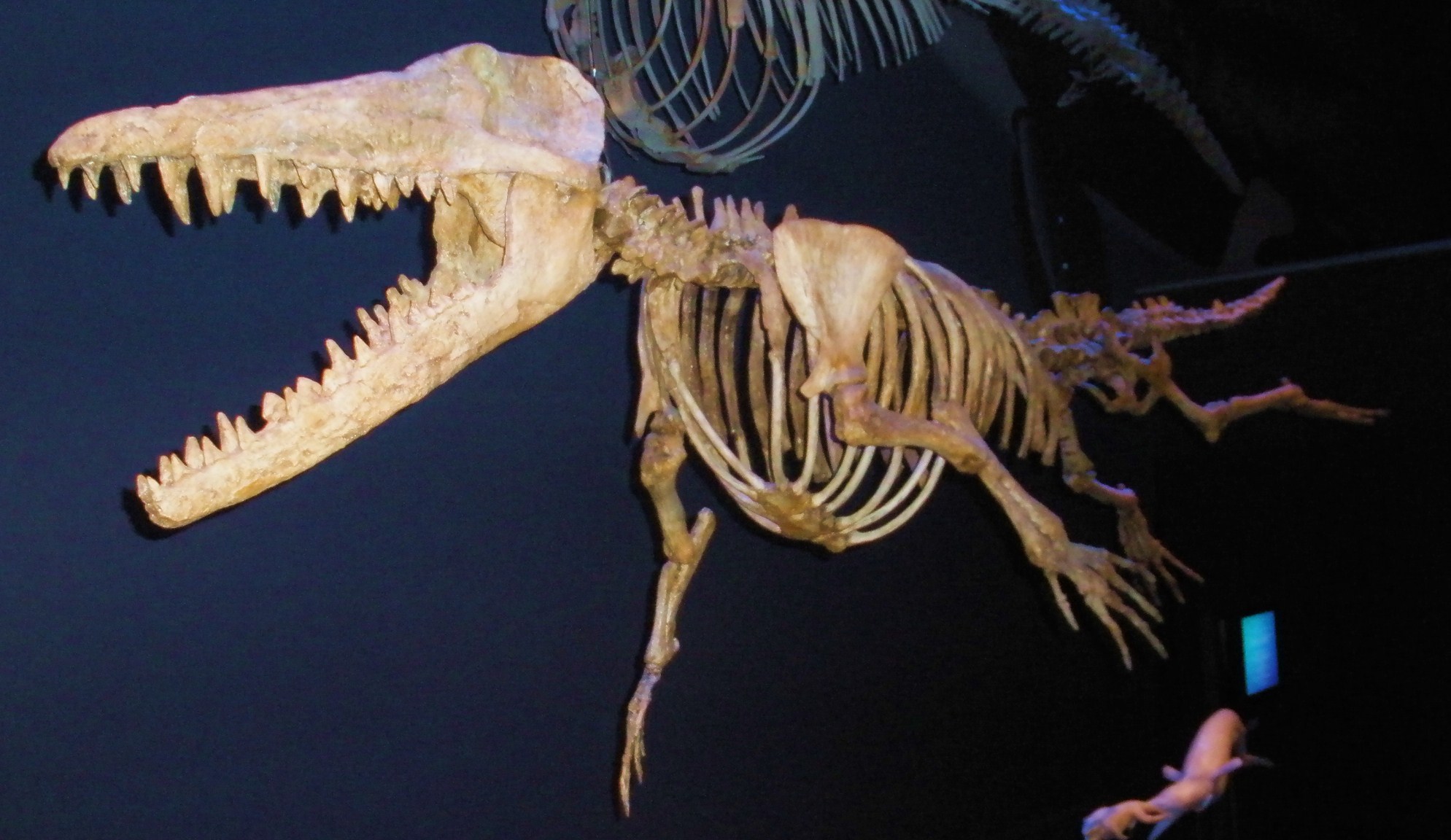
Believe it or not, this is one of the early ancestors of cetaceans like whales and dolphins. Mesonychids (hoofed predators) such as Andrewsarchus (the largest land predator to exist... I may blog about it later, its awesome) are also theorised to be related to them...

Messel also had giant ants, 5.5cm long.


Its funny that pretty much everything in this post could be the subject of its own separate, much longer blog post!

... why am I posting this? I really have no idea. Hope you found it vaguely interesting.


Even if the morrow is barren of promises, nothing shall forestall my return...

Becky x

Thursday, 27 September 2012

Off to university!

I go to uni tomorrow! I'm dead excited, but a little nervous too!

Commissions and sales are now closed. See my previous blog post for the details, but if theres something you want I'm more than happy to reserve it for you, provided its not already been sold in the shop.

Here are a few new pairs of earrings I've made:

 
These are made from miracle beads strung in a chain. I wanted to use ear hooks but I'd run out so had to use studs instead.
 
When wearing earrings, do you prefer studs or hooks? 

 
 Secondly, two lovely pieces of shell hung on wire with acrylic shell beads. My camera whitewashed this picture, sorry, the shell beads have a lovely streak of bluey green running across them which is a lot brighter than you can see here!

A few purchases for university:


Found this on ebay, its supposedly a limited edition Square Enix product. Whether it is or not I dont know (it does look authentic, but I dont know enough to judge), and I dont really care, because its awesome.

 
I couldnt find a decent bag to take to lectures anywhere, so I bought a cheap plain one and decorated it with lots of badges. Again, my camera kind of ruined this picture and you cant read the Game of Thrones badges (which are the best, especially the House Stark one). I bought those badges in Waterstones for £4.99, which was a bit expensive, and I got House Baratheon, Stark, Tully and Greyjoy. I'm very tempted to go back and get the other pack, which was Targaryen, Lannister, Arryn and a picture of the Iron Throne.
The other badges are mostly steampunk or random ones I bought at the Nemacon Artists Alley, and a few from David and Goliath (I love that shop).

 
Apparently my face when I saw this jumper in H+M was priceless! I just had to buy it...


Puppy love!!! Her name is Poppy and she's very mischievous but I love her to pieces. Here she is investigating the camera.

Have you all gone to university yet? What did you get up to in Freshers Week?


Even if the morrow is barren of promises, nothing shall forestall my return...

Becky x

Friday, 2 March 2012

Leaf nosed bats

Scientists have discovered a new species of leaf nosed bat in Vietnam, named Rhinolophus griffini, or Griffin's Leaf Nosed Bat.

A new species of leaf-nosed bat.<- the nose leaf is a bit ugly, but its very useful for finding prey

Like others in Rhinolophidae it has leaf shaped nose projections to aid in echolocation. Now it was good timing that I found out about this new species today, as I've spent all afternoon writing up my physics coursework on how these features help with echolocation.

Turns out each nostril acts as a point source for sound waves, creating an interference pattern in the emitted waves. This is where waves that are in phase combine constructively and those out of phase combine destructively and cancel. This creates a pattern as shown below:


The effect of this is to narrow the beam of sound, and enable the bat to hunt better - like carrying a torch in the dark, the narrow beam of light is able to illuminate far more detail than a candle.

That being said, it appears having quiet echolocation calls can also be an advantage. The Barbastelle (Barbastella barbastellus), a British bat (yay!!), has very quiet whispering echolocation calls.

Some moths have evolved a mechanism of defence against bat echolocation calls, that is, they have ears which can hear the echolocation signals and allow the insect to escape. Some, such as the tiger moth, even emit jamming pulses.

However, the pulses emitted by the Barbastelle are too quiet to be picked up by the moth's ears (like a candle rather than a torch, harder to be detected), and so the bat can catch the moth! Awesome!
Although, this does mean that the bat limits its all round 'vision', it gives it a distinct advantage over the moths. And its unlikely the moths will evolve further, as if they could hear vibrations on the same scale as the Barbastelle's calls, sounds such as the rustling of leaves or the wind would be far too loud and unbearable.

As National Geographic put it: bats 1, moths 0.

 <- far cuter, IMO