Showing posts with label zoology. Show all posts

Sunday, 27 October 2013

Moooths!

'Moths! They come out at niiiiiight!
Moths! They able to fliiiiight!
Moths! Theyre confused by liiiiight!
Moths! Theyre mothylicious!
Moths! Theyre not delicious!
Moths! Mooooooooths! Moooooooths!'


Several months ago I went on a field trip and did a project on moths. My boyfriend decided he wanted to help and composed the above song.

As I am currently snowed under with writing up the results of said project, I decided to write a post all about moths!

This will take the form of a 'top ten' of my favourite moths which we caught during the week, and why they are so awesome (because moths are awesome, and I never realised it before).

10. Burnished Brass

 
Yes, its wings really were that shiny!
 
9. Cinnabar


These moths liked to play dead, which made testing their behaviour very difficult. Then after a while they became extremely active, meaning I spent a lot of time chasing the escapees around the lab trying to catch them again.

Its bright colours are a warning signal to predators that the moth is unpalatable. The larvae absorb toxic and bitter compounds from the plants they eat, which are then incorporated into their own body.


8. Beautiful Golden Y


It really lives up to its name with the purple and gold colouration. The wings are also slightly reflective (although not as much as the Burnished Brass above).

7. Eyed Hawkmoth

 (my own photo)

This is the first of the hawkmoths to make the list, although all of the ones we caught were amazing in their own right. I loved this one because of the beautiful eye spots and the unusual wing posture (which was a characteristic shared by some other hawkmoths, such as the poplar which just missed out on this list).

6. Alder Kitten


The first morning I genuinely thought a bird had managed to poo inside the trap... but it was just a very well disguised moth!

5. Elephant Hawkmoth


Like many others on the field trip, I was surprised that moths this brightly coloured lived in the UK. There are two species, the Large E.H and the Small E.H, which can be told apart by their wing shape. The photo above is the L.E.H.

4. Pale Tussock


 (my own photo)

Nicknamed Yeti Moth by my friend, partially for its fluffy white appearance and partially for its habit of holding its wings up as seen in the photo above.

3. Buff Tip


The camouflage on this moth is incredible.


Is it a twig? Or is it a moth?

2. Privet Hawkmoth

I will never forget that moment on the first morning when, after finding lots of smaller moths, we turned over another part of the trap and saw... this.

 
The Privet hawkmoth is one of the largest moths to live in the UK, and when disturbed it flashes stripes of purple on its abdomen.

1. Buff Arches!


The swirly abstract patterning of the wings is very good camouflage for twigs and leaves, as well as being very beautiful.

I haven't gone into too much detail on the moths above as I should really be doing something other than procrastinating right now, but I hope you enjoyed that quick glimpse at the diversity of moths in the UK!

On a more general note...

As a China Mieville fan, I could really see where he got the inspiration for the slake moths in Perdido Street Station from - not just the insect facial features, but also the incredible wing patterns.

 (my own photo)

I also loved some of the crazy names naturalists have given moths over the years: Uncertain, Anomalous and Pebble Prominent were some of my favourites.

(disclaimer, all of the photos except those marked as my own were found on google. If you are the owner of one of these pictures and do not wish for me to use it, please contact me.)

Tuesday, 6 November 2012

The bat cardiovascular system!

My physiology homework:
'Find a recent paper (last 5 years) related to the function of the cardiovascular system, avoiding reviews; that you will present to the group next week'

In order to make this slightly more interesting, I'm blogging about my topic.

You may recall last time I blogged I mentioned my EPQ on bat wings... well, as part of that EPQ I wrote a very brief summary of adaptations in the bat cardiovascular system for powered flight. I didnt really understand much of it at the time, and as it only made up a few small paragraphs in the report I didnt include much detail. After posting the blog a few days ago I reread my EPQ, leading to my decision now to try to improve my knowledge on this topic.

So.... my findings for my EPQ were basically that: the bats heart is very large relative to its body size, with smaller cardiac muscle fibres than for other mammals. This allows more fibres to be compacted into a smaller volume. The venous system (veins) is also different from other mammals as if acts as a storage reservoir for blood, and contains special shunts to help control blood flow. The storage reservoir could have a function in heat regulation during flight or hibernation.

My research paper is entitled 'Application of local heat induces capillary recruitment in the Pallid bat wing'.

If the dilation of the arteries is inhibited by a blockade of a protein called NO synthase, the blood flow through the wing still increases when heat is applied. The aims of the study were to see if this is due to the capillaries.

Bats were trained to remain resting in a box while the heat was applied, and various pieces of equipment were used to take measurements.
There were three main experiments carried out, and each one was tested both with and without the pharmacological blockade.

1. The first aimed to measure the response of the arterioles to local heat, by finding out the blood vessel diameter and the red blood cell velocities
The results from this experiment confirmed the previously known results by showing that the blockade prevented any dilation through the arterioles. The blood flow in the wing, however, continued to increase despite this.

2. The second measured capillary perfusion (ie how many capillaries were in use). With heating, the number of capillaries in use increased, and this was unaffected by the blockade.

3. The final one measured the activity of structures called precapillary sphincters (which basically open and close to allow blood through the capillary or not). Similarly to experiment 2, the sphincters stayed open for longer and were unaffected by the blockade.

The results showed that capillary recruitment is induced by local heat, and this is independant of the blockade of the substances. The mechanisms through which this acts are currently unknown, but the results suggest some interesting potential causes.

The techniques have been suggested to be of some use to humans, with possible uses for diagnosis of diabetes and kidney failure.

All credit to the authors of the paper: Widmer RJ, Stewart RH, Young MF, Laurinec JE, Laine GA, Quick CM. http://www.ncbi.nlm.nih.gov/pubmed/17332157 


Even if the morrow is barren of promises, nothing shall forestall my return...

Becky x


Wednesday, 31 October 2012

Messel Shales

I love the Messel Shales. Have I not mentioned this before?

How silly of me... anyway, yeah. The Messel Shales are one of those incredible palaeontology discoveries that crop up a lot in recent fossil finds. Messel is of particular interest to moi as it is well known for its well preserved bat fossils.

The Messel Shales are located in Germany, and palaeontologists believe it was once a deep lake with a lack of oxygen at the bottom. This meant it did not contain the normal bacteria for decomposition as other lakes, resulting in beautifully preserved fossils. Examples include an ancestor of the woodpecker with detailed tail feathers and insects still retaining their original colour pigments. There have been many discoveries of bat fossils here, most with their wings folded back as if they were diving or falling out of mid-air.


This is my own replica fossil bat, Palaeochiropteryx tupaiodon. The original is shown above.

I did some calculations of wing morphology for my replica as part of my EPQ, and my findings showed it to have wings typical of insectivorous bats. This suggests it was a slow flyer which hunted close to the forest floor, with slow flight but high manoeuvrability in midair. This low flight speed may have made it particularly vulnerable to the poisonous gases from the lake (explained below).

Analysis of the geology of the lake has helped to understand why the fossil bats looked this way. It has been suggested that if carbon dioxide accumulated in the oxygen deficient water at the bottom and was then mixed with the normal water above, a large volume of poisonous gas would suddenly be released. This occurred at Lake Nyos in Cameroon, 1986, when carbon dioxide was released from the lake and killed over 1700 people. The similarities in the geology of the two lakes have lead scientists to believe Messel was similar, especially the presence of siderite at both (which is thought to indicate the presence of carbon-dioxide in lakes). Also, 50 million years ago the Messel Shales were situated on top of an active fault line, which suggests a cause for the mixing of the two types of water.

More fossils!


Jewel Beetle with color and iridescence

Jewelled wing beetle. The preservation of coloured pigments in fossils is really really rare.


Ida! (I hope you've all heard of this one, it got a lot of media attention). This is presumed to be representative of one of the missing links in the early evolution of primates.


Frogs.

Leptictidium

Leptictidium, as featured on BBCs Walking With Beasts (I may talk about this more in a later post... essentially, this programme was one of the things that got me interested in palaeontology when I was little. Also, Mesozoic fauna gets too much attention! Cenozoic animals are interesting too!)

The BBC programme featured the Messel fauna in its first episode, focusing on the Eocene. This period of the Earth's history occurred after the extinction of the dinosaurs, and is the time when the major mammal groups diversified. At this time, the apex predators were things like Gastornis, below:

Gastornis

...and also Ambulocetus:

File:Ambulocetus natans.jpg

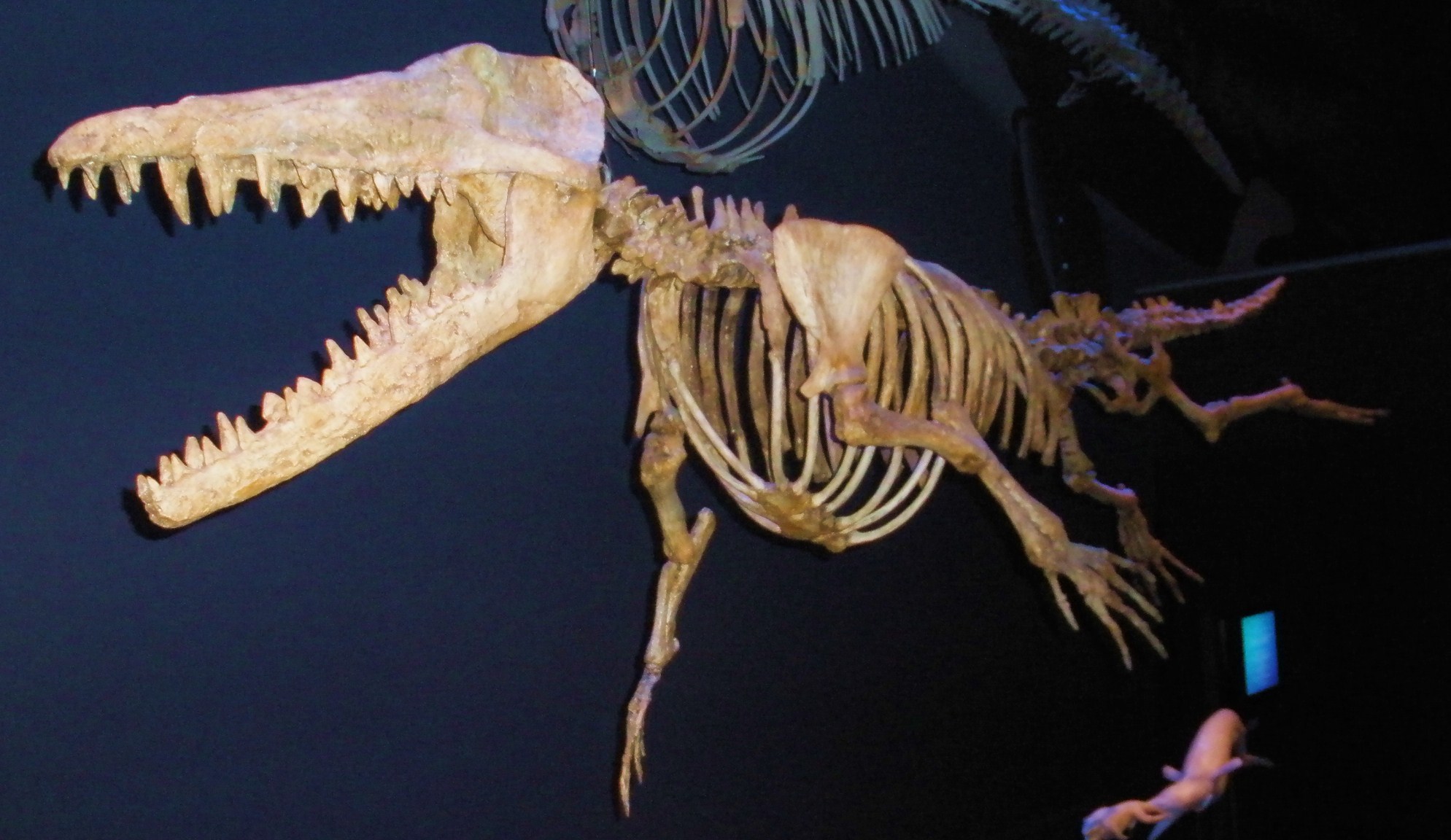
Believe it or not, this is one of the early ancestors of cetaceans like whales and dolphins. Mesonychids (hoofed predators) such as Andrewsarchus (the largest land predator to exist... I may blog about it later, its awesome) are also theorised to be related to them...

Messel also had giant ants, 5.5cm long.


Its funny that pretty much everything in this post could be the subject of its own separate, much longer blog post!

... why am I posting this? I really have no idea. Hope you found it vaguely interesting.


Even if the morrow is barren of promises, nothing shall forestall my return...

Becky x

Thursday, 6 September 2012

Octopods

The next part of my jewellery update. This started off as an experiment with the oval shaped beads, but I really like how they came out!


The beads are glass and the eyes are made from hematite. These little guys are super cute and every one is unique as the tentacles are always different!

I couldnt decide between pendants and earrings, so I'm going with both. Earrings are £12.50, and pendants are £6.99. If you dont want one in red or blue, let me know, and I'll see if I can get hold of the beads in different colours for you!

So, in honour of my new octopus-themed jewellery, this blog post is all about cephalopods!


A group of octopus is called a consortium. The correct version of the plural is either octopuses or octopodes, with octopi being incorrect as the word does not have a latin origin.

Octopuses have three hearts; two of which pump blood through the gills and another which pumps blood to the rest of the body.

In our blood cells we have haemoglobin as the oxygen carrying molecule, which is stored in our red blood cells. Octopuses, however, use haemocyanin dissolved in the blood plasma (the liquidy stuff which blood cells are found in), and this makes the blood appear blue.

Octopuses are very intelligent creatures, and are the only invertebrates which have been observed to use tools.

This one can use a rubiks cube, which instantly makes it more intelligent than me. I cant solve them at all :(
 
Although several species of octopus are venomous, the only one which is deadly to humans is the blue ringed octopus:
 
 
Octopuses are poorly represented in the fossil record as their bodies are almost entirely made up of soft tissues which decompose very quickly after death. The precise conditions needed for a fossil to form are rare - no scavengers, anoxic conditions (lack of oxygen which would prevent bacterial action) and rapid sedimentation rate (the body is buried quickly). However, fossils have been found.
 
 
This specimen is around 95 million years old, and shows very little difference to modern octopuses. Due to the extreme rarity of fossils, the evolutionary history of these animals is unknown.
 
I hope you like the new jewellery!
 
Even if the morrow is barren of promises, nothing shall forestall my return...
 
Becky x


Thursday, 16 August 2012

Update

Boring title is boring. Lots of interesting things in this post! (hopefully)

I've been on holiday, hence the lack of updates. I went to Austria and then the Olympics.

Awesome Ice Age carvings.


Omnomnom its called a Coupe Danemark (vanilla ice cream, hot chocolate sauce and cream)


Obligatory photo of some mountains.


A German athlete who let people pose for photos with his gold medal!


Me in the stadium.


Usain Bolt getting ready for his 200m victory.

Also, today was results day! I was extremely shocked to get a fantastic set of results, and I'm so excited that I will be going to Queens' College Cambridge to study Natural Sciences! Cannot wait!!!


Now off to have a little mini pizza takeaway party with the family to celebrate! Wooh!

Did you get results today? How did they go?

I hope you all did fantastic and got into the uni you wanted to!

Even if the morrow is barren of promises, nothing shall forestall my return...
Becky xx

Friday, 20 July 2012

Megalodon... also, name change!

Yeah, things got a bit confusing and I decided to rename the blog. Well, technically its not renaming it, its just reshuffling the url of my old blog 'Halcyon Days Jewellery' and this one. 'Compendium of dreams' was really a rushed, last minute name choice and I couldnt think of anything else at the time. When I found out you could, in fact, change it, I decided it would be good in the long run if I did so.

Sorry for any confusion! This makes it a lot easier for business cards/in-progress-etsy-account if the name of my 'website' matches the name of my business!

To confirm, the old blog (which was really just an extension of my dA account) is now called Compendium of Dreams and this blog is now Halcyon Days. Again, I'm sorry...

On to the main reason for this post...

As you are no doubt aware, I went swimming with sharks recently as a birthday present. So this blog is about one of my favourite prehistoric creatures: Megalodon, the biggest shark to have ever lived.

Perhaps the most interesting (and scary) fact about Megalodon is its sheer size. To put it in perspective, this is a Megalodon tooth and two Great White Shark teeth(the largest predatory fish currently alive):

An early jaw reconstruction:
Aaaaaaannd heres the scale vs a Great White and a human:
This was one BIG fish. Not the biggest fish ever (Leedsichthys, I think, is the current title holder), but definitely the biggest predatory fish. This shark was so large it ate whales, which we can figure out from serration marks on the teeth and in fossilised whale bones.

Don't worry, it is EXTINCT. No one really knows why it went extinct, but current theories suggest the changing water temperature is to blame. Like many other creatures like it (Loch Ness Monster plesiosaur anyone?), there are cryptozoological theories that these sharks have survived in deep sea trenches. It is true that we have not explored all of the ocean depths, but all the Megalodon teeth that are found are ancient, not recently shed as they would be if it was still alive (and sharks shed a lot of teeth). Despite the claims, no proof has yet been found.

And I really should point out, there are no sharks alive today anywhere near its size, and Jaws is all unrealistic scaremongering. You dont get Great Whites that size, and as I've just said, Megalodon is extinct. Sharks are beautiful creatures and deserve our respect. Even Great Whites, which admittedly are very scary creatures, command such power and agility in their hunting style that we should certainly admire them for it. All ecosystems need an apex predator, after all, and lightning strikes kill more people than sharks do. All that rubbish about them being bloodthirsty killers is not true at all.

Like all sharks, Megalodon was cartilaginous, which means instead of bones it had cartilage (the same stuff in your ear lobes). This also means that the only bits to be found fossilised are the teeth, and theres a lot of them about. A sort of average size is 7 inches, although they have been found bigger. Sharks go through several sets of teeth during their life, and are constantly growing new ones in rows to replace those lost.

Whilst in Edinburgh I decided to treat myself to a tooth, because its something I've always wanted.


My tooth is polished, which gives it a lovely, beautiful shine. It's almost complete, with only a small bit of the root missing, and the edge is still sharp and serrated. Its not especially large, as Megalodon teeth go (still as big as my hand!), but the larger ones were verging on £200 which was too expensive for me.

But I like the one I've got! It looks nice in the cabinet next to my Yellow River fishie, ostrich egg and trilobite. I'm building up a nice little collection here!


What do you guys collect? Anything special/expensive?

Oh and expect a jewellery update pretty soon :D

Even if the morrow is barren of promises, nothing shall forestall my return...

Becky xx

Wednesday, 11 July 2012

Shark dive

Got back from my shark dive!! It was amazing!

Just to remind you from my blog a while ago, I went swimming with Sand Tiger sharks at Edinburgh for my 18th birthday. They had 7 of them, the biggest of which was 12ft long.

Here's a few pictures from the tunnel:


The tunnel was really long, and they had several other types of shark in there as well as the sand tigers (tope and angel).

Heres some pictures of the dive itself!


The sharks werent bothered at all that we were there. They obviously get a lot of divers in with them, so they just cruised around and mostly ignored us.


There was one moment when a shark dived a little too close to the diver next to me and the instructors had to push it a little out of the way, but it wasnt aggressive at all, just curious.

Sand tiger sharks look very ferocious due to their protuding teeth, but they actually arent a threat to humans, even in the wild. They are found mostly all over the world, and have several different names depending on where you are.

They are possibly unique among sharks as they come to the surface to swallow air to aid with buoyancy, and they also have an unusual method of reproduction where the most developed embryo eats the less developed ones. This sounds a bit cruel, but it increases the chances of the young surviving after birth.

I feel very privileged to have been able to share their world for a short amount of time and would love to do it again!


Even if the morrow is barren of promises, nothing shall forestall my return...

Becky xx


Tuesday, 3 April 2012

Birthday plans! And horseshoe crabs :3

I know my birthday isnt till July, but plans are already well underway... I mean, come on, you only turn 18 once, right?

I am super excited about this.


I'm going to swim with sharks!!!!! How awesome is that?? Its at Edinburgh Aquarium, and we're also going to go see the pandas at the zoo while we're up there (and go shopping, of course =P).

Haha I didnt realise just how big these sharks were... They have one thats 12ft long (ironically named Tinkerbell). 12 ft. That is one damn big shark. 

Trying to find the link on youtube to the best video which shows just how big it is... Finding lots of encouraging videos called things like 'When Shark Dives Go Wrong!!', which is nice. Several friends have already said they're convinced I'm going to be eaten and want me to promise to ring them on the train home to tell them I'll alive =D

So excited about this!!! Actually cannot wait!!! (Although I'll be honest, I am slightly scared...)

Anyways...

I figured it was about time I posted a blog about these little critters. Horseshoe crabs.

I saw them for the first time in one of those documentary programmes, and my reaction was 'That's CGI. Creatures like that dont actually exist!!' They looked so prehistoric, like they belonged in Walking With Dinosaurs or something, I was amazed to find that they do exist.

And they are damn awesome. I mean, look at them.


They're so cute (in a weird kind of way), little shuffly things that look like trilobites but arent trilobites. I saw some specimens in uni museums which made me even more interested, they're such fascinating, unique animals. Like bats, I suppose.

(And speaking of unis, I finalised my choices on UCAS the other day, EEEEK D= )

Horseshoe crabs are a great source of interest to scientists because of their blood, which doesnt contain haemoglobin like humans (red) but haemocyanin (blue). They are harvested for their blood, which I think is rather cruel, especially given the mortality rates, but this has lots of potential medical benefits for humans.

They're one of these amazing animals (like sharks) which have been around for millions and millions of years unchanged by evolution.


Now this doesnt really make a lot of sense to me (as an amateur palaeontologist about to enter uni). Reading about dramatic extinction events like the End-Permian (which wiped out 95% of all species) or the more well known KT event (think meteorites and dinosaurs), it seems so unlikely that a creature could survive something like that - not only once, but several times! These animals (and sharks and other living fossils like turtles too), have survived many of these events, and remained virtually unchanged on the other side!

Perhaps living in the sea gives an advantage, as the environment tends to remain more constant than on land. But then again, certainly for the End Permian, the evidence suggests anoxic conditions which would have caused difficulties for aquatic life as well as terrestrial.

And that is why I want to be a paleontologist, my friends. So many mysteries out there, so much more that is not understood!

Sorry for boring you all with my palaeo rants =D Hope you're having a lovely Easter, wherever you are!


Much love, Becky xx
PS: you can now sponsor me online for my 27 mile charity walk!! (see other blog post) Please help us raise lots of money to help the 27 million worldwide who are victimes of slavery!! Thank you!  http://www.justgiving.com/Rebecca-Bennion